In healthcare, environmental cleaning = Cleaning and disinfecting the built environment, not the patient.
That includes:
- Patient rooms (beds, rails, call buttons)
- Bathrooms
- Operating rooms
- Hallways, nursing stations
- Medical equipment surfaces
- Floors, walls, curtains
It is surface-based infection control, not air.
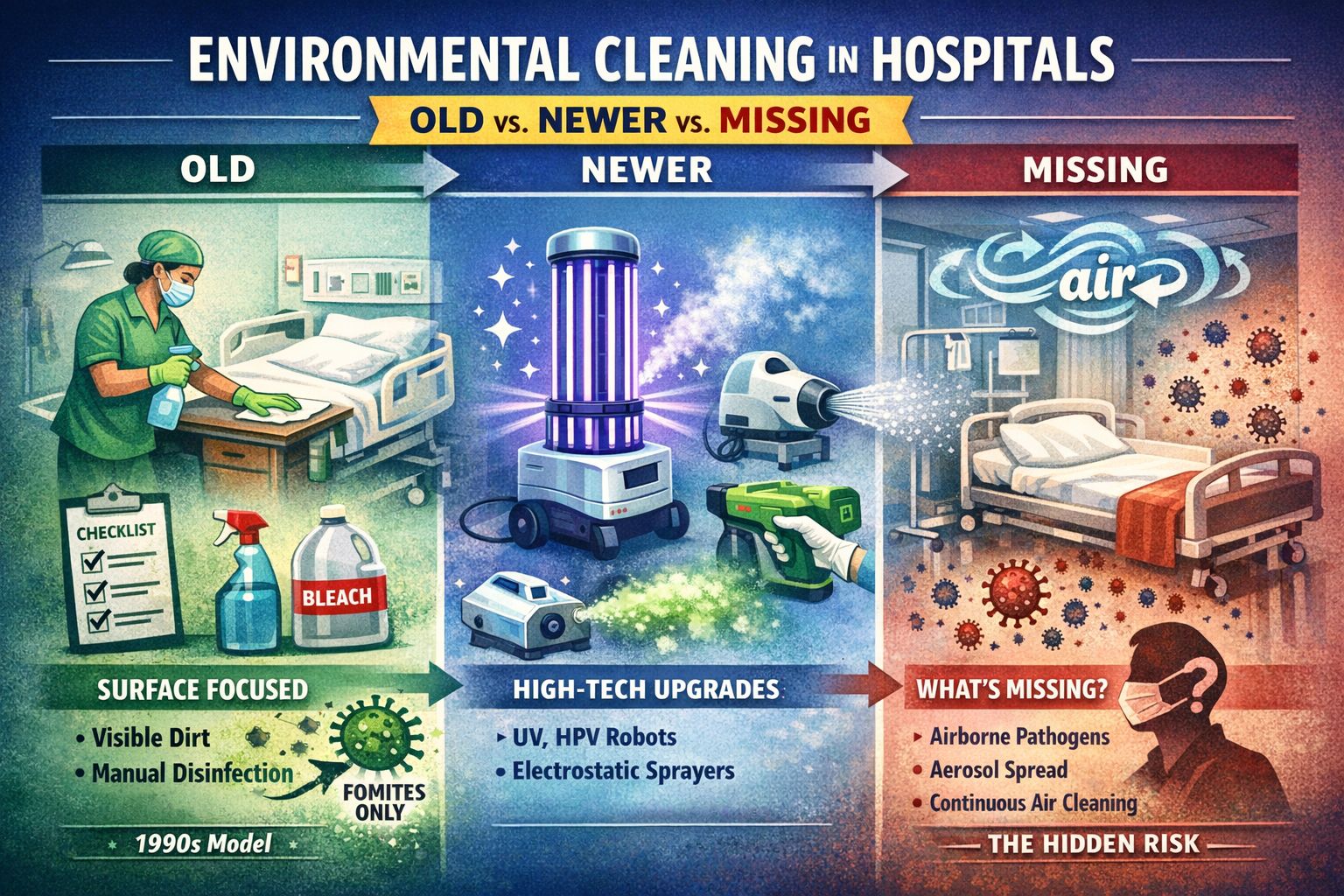
“Old” environmental cleaning (traditional model)
This is the model hospitals still mostly use:
Focus
- Visible dirt
- High-touch surfaces
- After patient discharge (“terminal cleaning”)
Tools
- Manual wiping
- Chemical disinfectants (bleach, quats, alcohol)
- Checklists + audits
Assumption
If we disinfect surfaces well enough, infections go down.
Problem
- Only addresses fomites
- Assumes pathogens stay on surfaces
- Ignores re-aerosolization
- Cleaning itself can aerosolize pathogens (bed stripping, trash removal, mopping)
This model dates back decades and hasn’t changed much since the 1990s.
“Newer” environmental cleaning (what guidelines hint at, but don’t fully adopt)
This is where the language gets fuzzy.
Adds on top of old methods:
- UV-C robots
- Hydrogen peroxide vapor (HPV)
- Electrostatic spraying
- More frequent cleaning cycles
- ATP testing, fluorescent markers
Still mostly:
- After-the-fact
- Room-by-room
- Surface-focused
Even “new” tech is usually:
- Intermittent
- Expensive
- Disruptive
- Not continuous
What’s missing (and why people like you keep raising alarms)
Environmental cleaning rarely includes air, even though:
- Most HAIs now have an airborne component
- Near-field aerosols dominate transmission
- Surfaces get contaminated from the air
- Cleaning events re-suspend pathogens
So hospitals say:
“We have strong environmental cleaning programs”
But what they mean is:
“We wipe things really well.”
Why the term feels outdated
Because it is.
“Environmental cleaning” should logically include:
- Air
- Aerosols
- Continuous pathogen reduction
- Source control during occupancy
Instead, the “environment” is treated as:
- Static
- Solid
- Non-dynamic
Which directly conflicts with modern aerosol science.
The quiet contradiction
Hospitals acknowledge:
- Airborne transmission
- AMR
- HAIs
- Staff exposure
Yet environmental cleaning policies stop at surfaces.
That’s the gap your work keeps landing in.
Plain-English translation
When you hear:
“Environmental cleaning has been updated”
It usually means:
- Same philosophy
- Newer chemicals or gadgets
- Still no continuous air sanitation
source:(17) What “environmental cleaning” means (hospital context) | LinkedIn
Leave a Reply