

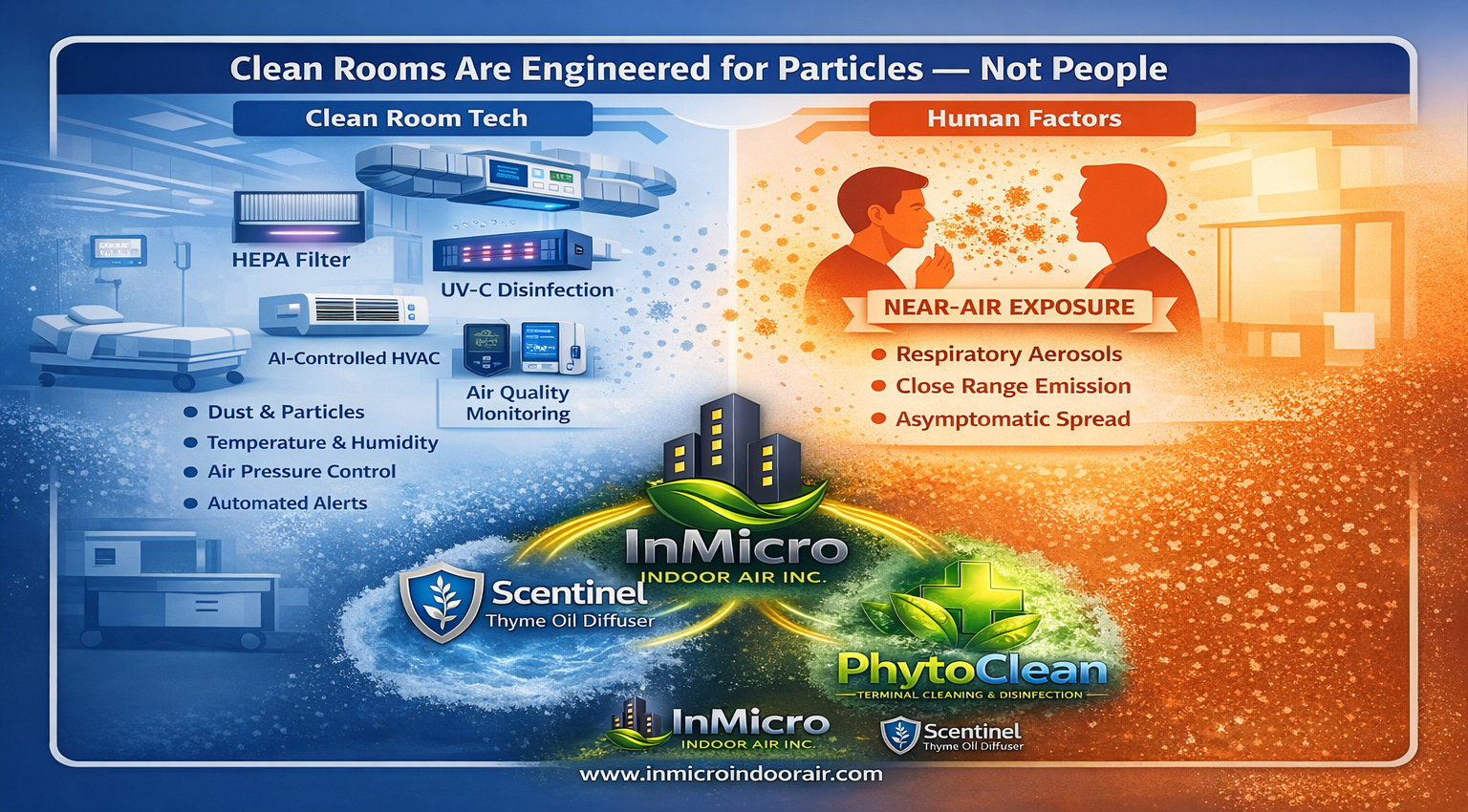
Over the past four decades, hospital infection control has become increasingly sophisticated. Clean room construction follows international frameworks such as ISO 14644-1 and the legacy FED-STD-209E. Facilities integrate HEPA filtration, UV-C disinfection, automated pressure controls, AI-optimized HVAC, and continuous monitoring systems. Companies offer advanced solutions—from the Puritrak air purifier and Puritrak indoor air quality measuring device to Puritrak outdoor air quality measuring device platforms and integrated AQM solutions—designed to remove 99.97% of particles at 0.3 microns, stabilize humidity, and trigger real-time alerts when thresholds are exceeded.
On paper, this is a triumph of engineering.
But during the pandemic, one biological reality exposed a fundamental flaw in how we conceptualize “clean”: people contaminate indoor environments simply by breathing.
Clean Rooms Are Engineered for Particles — Not People
Hospital clean room construction focuses on controlling:
- Dust
- Temperature
- Humidity
- Pressure differentials
- Air changes per hour (ACH)
The standard process is rigorous:
- Site assessment
- Detailed airflow and pressure design
- Installation of HEPA-based ventilation systems
- Final validation and inspection
- Ongoing monitoring and maintenance
Technologies include:
- Continuous ventilation systems
- HEPA filtration (≥99.97% efficiency at 0.3 microns)
- Air conditioning with humidity stabilization
- Air quality meters
- Automated monitoring and alerts
- UV-C disinfection modules
- Antimicrobial wall and ceiling panels
- Seamless vinyl or epoxy flooring
These systems reduce airborne particle concentration effectively.
But they do not stop the moment of emission.
The Near-Air Problem
Humans continuously emit respiratory aerosols through breathing, speaking, coughing, and even quiet exhalation. During COVID-19, asymptomatic and presymptomatic transmission demonstrated that individuals without symptoms can release infectious aerosols in ordinary indoor settings.
Even if 60–80% of infected individuals show minimal or no symptoms at certain stages, they still generate airborne particles. That means:
- Screening based on symptoms fails.
- Clean-looking air does not equal noninfectious air.
- Engineering systems are always reacting to contamination, not preventing emission.
Infection often occurs in the near field—within one to two meters of the infected person—before ventilation systems can dilute or filter the air.
Even at high ACH rates:
- Air mixing takes time.
- Filtration occurs after exposure risk begins.
- Continuous emission means the system is perpetually “catching up.”
This is not a failure of HEPA filters. It is a misunderstanding of exposure dynamics.
Why Advanced Monitoring Still Misses the Mark
Modern AQM systems measure:
- Particulate matter
- Temperature
- Humidity
- CO₂
- Volatile compounds
Puritrak indoor and outdoor air quality measuring devices can provide continuous environmental data. Automated alerts notify when parameters exceed thresholds. UV-C systems neutralize airborne pathogens that pass through treatment chambers.
But near-air infectious exposure can occur:
- Before room-level particle counts rise
- Before sensors detect anomalies
- Before air passes through filtration systems
- Within seconds of close interaction
Environmental monitoring captures room conditions.
Transmission often occurs in the breathing zone between two people.
That distinction matters.
Dilution Is Not Prevention
Ventilation is fundamentally a dilution strategy. It lowers overall concentration in a room. It does not eliminate:
- Close-range aerosol plumes
- Short-duration high-concentration bursts
- Direct face-to-face exposure
In operating rooms, positive pressure protects the surgical field from outside contaminants. In isolation rooms, negative pressure contains pathogens. These strategies manage airflow direction at a macro scale.
They do not neutralize freshly emitted aerosols in real time at the source.
Hospitals are not semiconductor fabrication plants. Microchips do not exhale. Patients, nurses, physicians, and visitors do.
The Illusion of Sterility
Marketing language often suggests that bacteria “cannot invade” clean rooms. In reality, microorganisms are constantly introduced by:
- Staff movement
- Patient respiration
- Door openings
- Surface disturbances
- Medical procedures
Clean rooms control concentration, not presence.
No matter how advanced the filtration, no matter how intelligent the building automation system, the biological source remains inside the controlled space.
What We Learned — and What We Didn’t
The pandemic revealed a critical oversight in infection control philosophy:
We optimized buildings. We did not fully optimize for biology.
Sophisticated solutions—including air purifiers, UV-C systems, smart HVAC, and advanced AQM platforms—are valuable components of layered protection. But they cannot compensate for a conceptual gap: failure to account for continuous human bioaerosol generation in the near field.
Without understanding:
- Emission rates from breathing
- Particle size distribution
- Short-range plume behavior
- Time-to-inhalation dynamics
We risk overestimating the protective power of room-level engineering controls.
The Next Phase of Hospital Design
True infection control requires integrating:
- Engineering controls (ventilation, filtration, pressure)
- Biological risk modeling
- Near-field exposure mitigation
- Source control strategies
- Administrative controls
- Personal protective measures
The future of hospital clean room construction in 2026 cannot rely solely on increasingly complex equipment. It must incorporate a deeper understanding of how people actually spread infections in real space and real time.
Because the built environment does not become contaminated primarily from outside infiltration.
It becomes contaminated because people breathe.
And until design fully integrates that biological fact, even the most advanced systems will only partially solve the problem.


Leave a Reply