

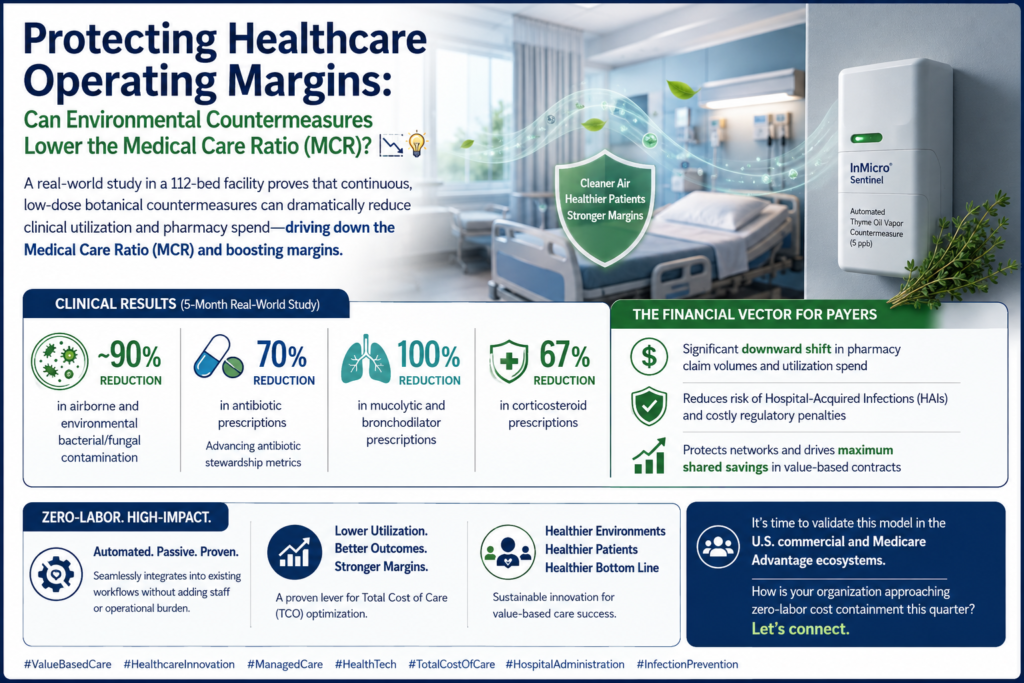
Air dispersed essential oils combined with standard sanitization procedures for environmental microbiota control in nosocomial hospitalization rooms.
112-Bed Residential Healthcare Facility
Italy | 2016
Scientific Publication & Reference
This case study is based on the peer-reviewed research article:
Gelmini F., Belotti L., Vecchi S., Testa C., & Beretta G. (2016). Air dispersed essential oils combined with standard sanitization procedures for environmental microbiota control in nosocomial hospitalization rooms. Complementary Therapies in Medicine, 25, 113–119. The study demonstrated that nebulized essential oils used alongside standard hospital cleaning procedures significantly reduced bacterial and fungal contamination while also reducing the need for several classes of medications in long-term care patients.
View the publication on PubMed:
View the archived full-text record from the University of Milan Institutional Repository (Italy):
University of Milan Institutional Repository (AIR-UNIMI)
Overview
Air-Dispersed Essential Oils for Environmental Microbiota Control in Hospital Rooms
Researchers investigated whether ultrasonically diffused essential oils (EOs) could reduce microbial contamination in hospital rooms when used alongside standard cleaning procedures. The study was conducted over five months in a 112-bed residential healthcare facility in Italy, comparing rooms treated with standard sanitization alone to rooms that also received continuous essential oil diffusion.
The essential oil blend consisted of lavender, cajeput, Siberian fir, myrtle, and geranium oils, dispersed through ultrasound vaporization for 16 hours each day without changing the facility’s existing cleaning protocol. Surface samples from tables, cabinets, and handrails were regularly tested for bacterial and fungal contamination.
Key Findings
- Over 90% reduction in bacterial contamination on room surfaces treated with essential oil diffusion compared with standard cleaning alone.
- Approximately 90% reduction in yeast and mold contamination was also observed.
- Microbial levels increased again after essential oil diffusion was stopped, indicating that the antimicrobial effect depended on continuous application.
In addition to environmental improvements, patients staying in the treated area required significantly fewer medications related to infections and respiratory illnesses:
- 70% fewer antibiotic prescriptions
- 100% reduction in mucolytic medications
- 100% reduction in bronchodilator prescriptions
- 67–77% reduction in corticosteroid use
- Overall reduction of 80% in prescriptions and 86% in treatment days, with no adverse effects reported.
Conclusion
The study suggests that air-dispersed essential oils can serve as an effective complementary infection-control strategy in healthcare environments. When combined with standard sanitization procedures, essential oil vapor significantly reduced environmental microbial contamination and was associated with lower medication use among patients. While the authors recommend further research to clarify the mechanisms involved, the findings highlight the potential of essential oil diffusion as a supportive technology for improving indoor environmental hygiene in healthcare facilities.
Disclaimer: This study supports the use of essential oil diffusion as a complementary measure, not a replacement for established hospital cleaning, disinfection, or infection prevention protocols.
Smile Dental Implant Centre
Surrey, British Columbia | May 2020
Overview
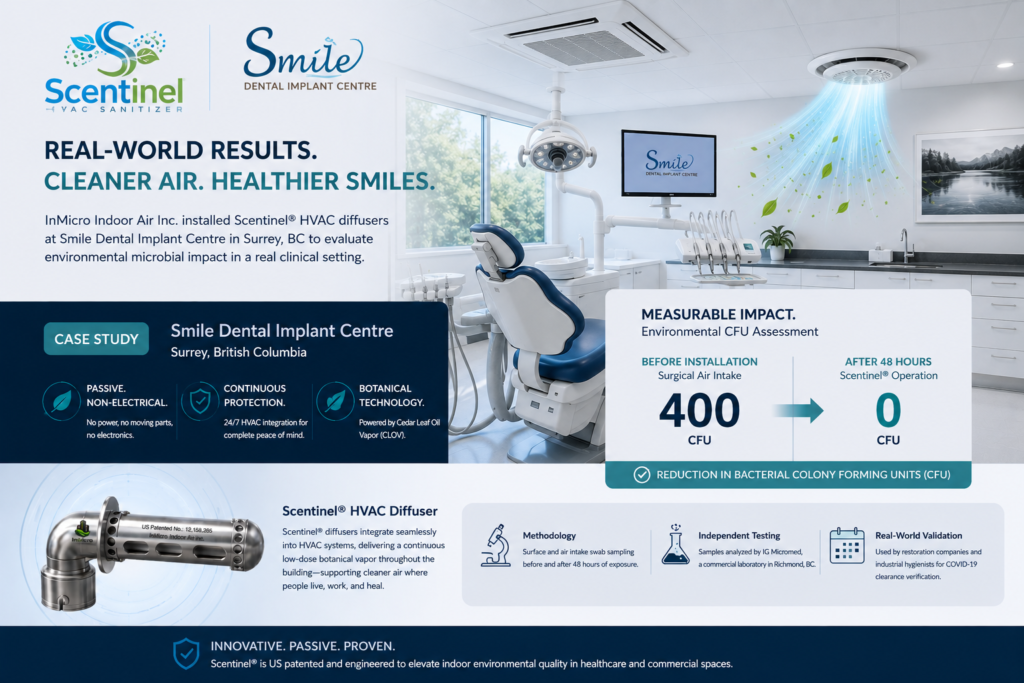
In May 2020, InMicro Indoor Air Inc. conducted an environmental surface and air assessment following the installation of Scentinel® commercial HVAC diffusers at the Smile Dental Implant Centre in Surrey, BC.
The objective was to observe changes in environmental microbial load (bacteria, virus, and mold indicators) following continuous exposure to a botanical vapor-based indoor air treatment.
Methodology
Two sampling points were selected within the facility:
- Dental operatory workstation keyboard (high-touch surface)
- Surgical air filtration intake (HVAC-related air pathway)
Swab samples were collected prior to installation and again after 48 hours of continuous Scentinel® operation.
Samples were analyzed by an independent commercial laboratory in Richmond, BC for total bacterial colony forming units (CFUs).
This type of pre- and post-environmental sampling methodology is commonly used in industrial hygiene and environmental remediation clearance assessments.
Intervention
The facility was exposed to continuous low-dose botanical vapor diffusion (Cedar Leaf Oil Vapor – CLOV) delivered through the Scentinel® HVAC diffuser system over a 48-hour period.
Scentinel® operates passively within HVAC airflow and is designed for continuous 24/7 deployment in occupied environments.
Results
After 48 hours of exposure:
- The dental operatory keyboard remained within expected low-contamination levels for a clinical setting
- The surgical air intake sampling site showed a reduction in measurable bacterial CFUs
Observed change:
| Sampling Location | Pre-Exposure | Post-Exposure |
|---|---|---|
| Surgical air intake | 400 CFU | 0 CFU |
Key Observation
The surgical air intake sample demonstrated a reduction from 400 CFU to non-detectable levels (0 CFU) following the exposure period.
This result suggests a strong environmental impact in airflow-associated sampling points under the conditions of this assessment.
Important Context
This was a real-world environmental assessment, not a controlled clinical trial. Results represent observed changes in microbial load under specific facility conditions and exposure duration.
Significance for Dental & Clinical Environments
Dental environments require strict control of airborne and surface contamination due to:
- High patient turnover
- Aerosol-generating procedures
- Constant HVAC air recirculation
This case study demonstrates the potential role of continuous HVAC-integrated botanical countermeasures in supporting environmental hygiene strategies in clinical settings.
Technology Used
Scentinel® HVAC Diffuser System
- US-patented HVAC diffuser technology
- No moving parts
- No electronics at point of diffusion
- Continuous 24/7 passive operation
- Integrates directly into HVAC airflow systems
Interested in Environmental Validation for Your Facility?
Discover how Scentinel® can be evaluated within your environment through a structured assessment protocol.


